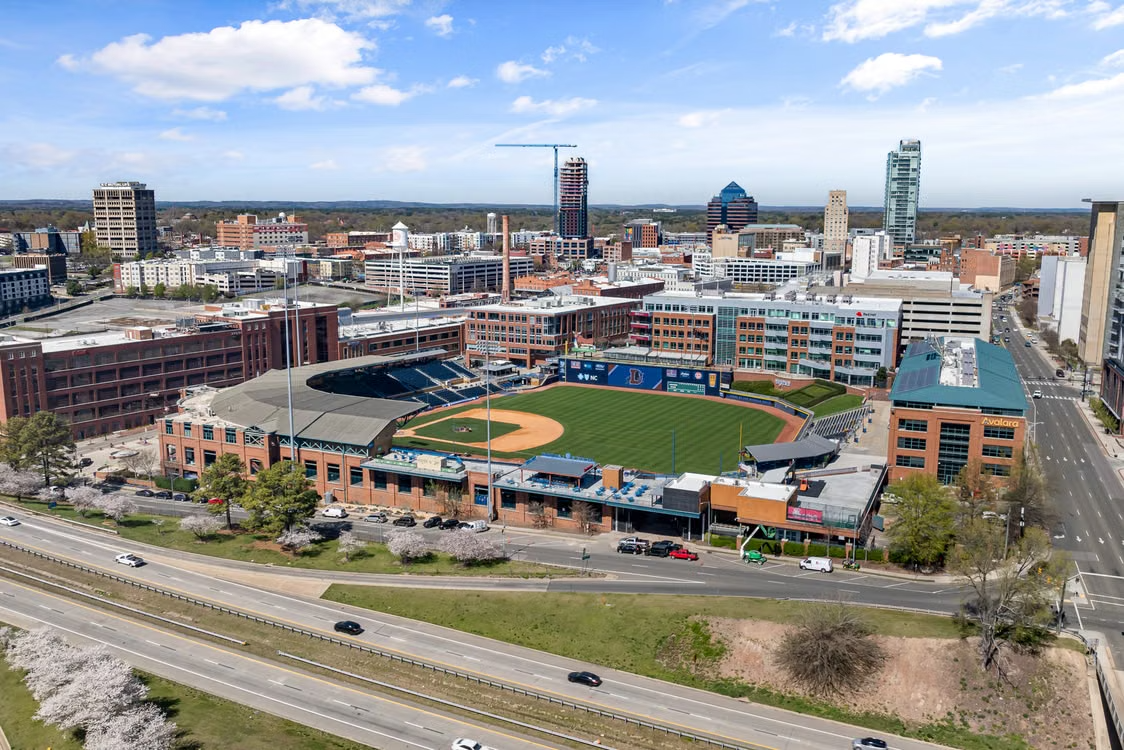
Durham is a former tobacco and textile city in North Carolina’s Piedmont, built around brick warehouses that now hold offices, restaurants, and apartments. It is home to Duke University and borders Research Triangle Park, pairing a compact downtown with wooded suburbs and creek-lined older streets.
If you are moving to Durham, the best neighborhoods in Durham include Downtown for walkable city living, Southside / St. Teresa for affordable close-in houses, and Hope Valley for wooded lots and quiet streets. This guide breaks down seven Durham neighborhoods by type of housing, commute, price, and the tradeoffs between them, so you can match a place to how you actually want to live. The big choices here are close-in apartment living versus a suburban house, an easy walk downtown versus a longer drive, and older character homes versus newer builds on bigger lots.
Quick Guide: Best neighborhoods in Durham for…
- Downtown: best for walkable city living, restaurants, and loft-style apartments.
- Old West Durham: best for the Ninth Street shops, Duke’s East Campus, and older bungalows.
- Southside / St. Teresa: best for affordable close-in houses, downtown access, and newer infill homes.
- Old North Durham: best for historic streets, downtown walks, and early-1900s houses.
- Central Park: best for the farmers market, weekend walks, and converted-warehouse apartments.
- Hope Valley: best for wooded lots, a historic golf course, and large houses.
- Parkwood: best for a lakeside setting, Research Triangle Park access, and modest ranch houses.
Explore more Rentals in Durham, NC on Trulia.
Explore more Homes for Sale in Durham, NC on Trulia.
At a Glance: Choosing Where to Live in Durham
- Close-in or suburban. Downtown and its neighbors put you in apartments and older houses within walking distance of restaurants and the farmers market. Head south to Hope Valley or Parkwood and you trade that for larger lots, quiet streets, and a car for almost everything.
- Rent or buy. The central neighborhoods are mostly rentals, much of it in apartment buildings inside converted warehouses. The suburbs and older residential streets are where most of the for-sale houses are.
- Getting around. Most of Durham needs a car. Only Downtown, Central Park, and the Ninth Street stretch of Old West Durham are truly walkable, and GoDurham (Durham’s public bus system) buses mainly serve the central neighborhoods.
- Old character or new build. Older neighborhoods near downtown have bungalows and early-1900s houses on smaller lots. South Durham has newer houses and planned communities on bigger parcels.
- Price range. Durham spans a wide range, from an average 3-bedroom house listing around $322,000 in Southside / St. Teresa to about $1,274,000 for a 4-bedroom in Hope Valley, based on Trulia data as of July 2026.
Durham neighborhood deep-dives
Downtown: The walkable center of the city
Downtown Durham is built around its old tobacco buildings. The American Tobacco Campus turned a row of brick factories into a courtyard of offices, restaurants, and a walkable plaza with a water feature running down the middle. A few blocks north, the Durham Performing Arts Center brings touring Broadway shows and concerts, and the ballpark fills up for Durham Bulls games on summer nights. You can walk from coffee to dinner to a show without touching your car.
This is one of the few parts of Durham where daily errands don’t need a car. Street parking is metered and fills up on event nights, so a garage spot with your apartment is worth asking about. GoDurham buses converge here, and the office parks in the Triangle are about 20 minutes out, closer to 35 at rush hour.
Housing downtown is mostly apartments, much of it inside converted warehouses with tall windows, exposed brick, and high ceilings, along with newer mid-rise buildings. Units are roomy for a city center, with the typical 2-bedroom apartment on the market around 1,168 square feet as of July 2026, per Trulia data. Outdoor space usually means a shared roof deck or courtyard, and covered parking is a common perk.
The Tradeoff: You get the shortest walk to restaurants and shows in the city, but you pay Durham’s higher apartment rents and give up a private yard.
If Not Here, Then… Try Central Park, just north, where the same loft-style apartments come with the farmers market and a quieter, more residential feel.
As of July 2026, based on Trulia data:
- Average rent (1BR Apartment): $1,706.
- Average rent (2BR Apartment): $2,389.
See rentals in Downtown, Durham and homes for sale in Downtown, Durham on Trulia.
Learn more about Downtown, Durham on Trulia.
Old West Durham: Ninth Street and the edge of Duke
Old West Durham grew up as a mill village and now centers on Ninth Street, a short commercial strip of bookshops, cafes, bakeries, and small restaurants that stays busy from morning coffee through dinner. Duke University‘s East Campus is right across Main Street, with a wooded loop of a little over a mile that draws walkers and runners all day. You can handle most errands on foot here, which is rare outside downtown.
Ninth Street parking is a mix of a small lot and metered spaces that turn over quickly, so plan to circle at busy times or park on a side street. GoDurham buses run along Main Street toward downtown, about 10 minutes east, and Duke is a short walk or ride.
The streets behind Ninth Street have early-1900s bungalows and cottages on modest lots, mixed with newer apartment buildings closer to the shops. Houses rarely come up for sale here, so it is mostly a place to rent, with about 180 rental units as of August 2026, most of them in apartment buildings, per Trulia data. Front porches and mature street trees are common, and yards are small.
The Tradeoff: You get a walkable strip and quick Duke access, but the small older houses sell fast and rarely at a bargain.
If Not Here, Then… Try Old North Durham, another older neighborhood near downtown, where more houses come up for sale.
As of July 2026, based on Trulia data:
- Average rent (1BR Apartment): $1,866.
- Average rent (2BR Apartment): $2,450.
See rentals in Old West Durham, Durham and homes for sale in Old West Durham, Durham on Trulia.
Learn more about Old West Durham, Durham on Trulia.
Southside / St. Teresa: Affordable and close to downtown
Southside / St. Teresa is one of the closest-in places to buy a house in Durham, a short distance south of downtown near North Carolina Central University. The neighborhood mixes rehabbed older homes with a wave of newer infill houses built in the last decade, and the American Tobacco Trail runs along its edge for walking and biking toward downtown.
You can reach downtown in well under 10 minutes by car, and GoDurham buses run along Fayetteville Street. Many houses have a driveway or off-street parking, so parking is easy compared with the older grids closer in.
For-sale inventory is largest here, with roughly 32 houses listed as of August 2026, the most of any neighborhood in this guide, per Trulia data. Restored early-1900s cottages stand next to newer two-story houses, and about 66% of the houses on the market list a garage as of August 2026, more than in the older grids nearby. The typical listing is a modest 3-bedroom on a small lot.
The Tradeoff: You get an affordable house minutes from downtown, but the streets are still filling in and lots are small.
If Not Here, Then… Try Parkwood to the south, where a house on a bigger lot costs a bit more but comes with a lake and the research park nearby.
As of July 2026, based on Trulia data:
- Average rent (1BR Apartment): $862.
- Average rent (2BR Apartment): $1,395.
- Average list price (3BR House): $322,000.
See rentals in Southside / St. Teresa, Durham and homes for sale in Southside / St. Teresa, Durham on Trulia.
Learn more about Southside / St. Teresa, Durham on Trulia.
Old North Durham: Historic streets by downtown
Old North Durham is a historic residential neighborhood just north of downtown, close to the bars and restaurants around Geer Street. Tree-lined blocks of early-1900s houses give it a settled, quiet feel, and you can walk or bike to the center in a few minutes.
Parking is easy on the residential streets, a change from the metered blocks downtown. GoDurham buses run toward the center, and downtown is about a 5-minute drive or a 15-minute walk from the southern edge.
Bungalows, four-squares, and other early-1900s houses line the streets, many on compact lots with front porches. The houses that come up for sale are mostly three-bedrooms, per Trulia data as of August 2026, and many have been restored. Rentals are common too, in smaller apartment buildings and converted houses.
The Tradeoff: You get historic character within walking distance of downtown, but the older houses list at a premium and the largest ones are rare.
If Not Here, Then… Try Old West Durham, another walkable older neighborhood, this one built around the Ninth Street shops.
As of July 2026, based on Trulia data:
- Average rent (1BR Apartment): $1,750.
- Average rent (2BR Apartment): $2,519.
- Average list price (3BR House): $504,750.
See rentals in Old North Durham, Durham and homes for sale in Old North Durham, Durham on Trulia.
Learn more about Old North Durham, Durham on Trulia.
Central Park: The farmers market neighborhood
Central Park takes its name from Durham Central Park, a five-acre green space just north of downtown that hosts the Durham Farmers’ Market on Saturday mornings along with food trucks and events. The blocks around it have galleries, a food hall, and small restaurants inside old industrial buildings, and it is an easy neighborhood to explore on foot.
Parking is a mix of street spaces and small lots that fill on market mornings, so arrive early on Saturdays or walk in. GoDurham buses and downtown are a few minutes away, and the Triangle’s job centers are about a 20-minute drive.
Housing here is mostly apartments and lofts inside converted warehouses and newer mid-rise buildings, with high ceilings and big windows. One-bedroom apartments are the most common rental on the market, per Trulia data as of August 2026. Private yards are rare, and outdoor space usually means a balcony or shared courtyard.
The Tradeoff: You get the farmers market and downtown at your doorstep, but rents are near the top of this guide and yards are rare.
If Not Here, Then… Try Downtown next door, where you get the same loft-style apartments plus the ballpark and the theater within walking distance.
As of July 2026, based on Trulia data:
- Average rent (1BR Apartment): $1,862.
- Average rent (2BR Apartment): $2,604.
See rentals in Central Park, Durham and homes for sale in Central Park, Durham on Trulia.
Learn more about Central Park, Durham on Trulia.
Hope Valley: Wooded lots and a historic golf course
Hope Valley is a wooded suburb in southwest Durham, laid out in the 1920s around a Donald Ross golf course at Hope Valley Country Club. Winding, tree-shaded streets and large lots give it a quiet, settled feel, and errands are a short drive to the shops along the main roads rather than a walk.
You need a car here for just about everything. Parking is a non-issue, with driveways and garages the norm, and downtown is about 15 minutes away, or 20 to the office parks in the Triangle, both easy outside of rush hour.
Large houses stand well back on some of the biggest lots in this guide. The typical 4-bedroom house on the market has a lot of about 20,909 square feet, close to half an acre, far larger than the close-in neighborhoods, per Trulia data as of July 2026. Styles range from 1920s and mid-century houses near the golf course to newer builds, and mature hardwoods shade the streets.
The Tradeoff: You get space, trees, and quiet, but you pay the highest house prices in this guide and depend on a car for everything.
If Not Here, Then… Try Parkwood to the east, where you still get a house on a big lot near the Triangle’s job centers, for much less.
As of July 2026, based on Trulia data:
- Average list price (4BR House): $1,274,000.
See rentals in Hope Valley, Durham and homes for sale in Hope Valley, Durham on Trulia.
Learn more about Hope Valley, Durham on Trulia.
Parkwood: A planned community with a lake
Parkwood is a 1960s planned community in south Durham, built around Parkwood Lake with its own pool, ball fields, and walking paths. It borders Research Triangle Park, the large research and office campus, which makes for one of the shortest commutes to those jobs of any neighborhood in this guide. Day-to-day shopping is a short drive to the stores along the nearby highways.
You need a car, but the payoff is the location. Research Triangle Park is only about 5 to 10 minutes away, and downtown Durham is roughly 15. Parking is easy, with driveways and carports standard, and the neighborhood streets are quiet and low-traffic.
Single-story ranch houses and split-levels from the 1960s and 70s make up most of Parkwood, on generous, wooded lots. The typical 3-bedroom house on the market is about 1,592 square feet as of July 2026, per Trulia data, a modest size that keeps prices reasonable for the lot you get. Carports, mature trees, and lake or greenway access nearby are common.
The Tradeoff: You get a house on a big lot minutes from Research Triangle Park, but the houses are older and modest, and you are well outside walkable Durham.
If Not Here, Then… Try Hope Valley to the west, where the lots and houses are larger and the setting is more wooded, at a higher price.
As of July 2026, based on Trulia data:
- Average list price (3BR House): $407,450.
See rentals in Parkwood, Durham and homes for sale in Parkwood, Durham on Trulia.
Learn more about Parkwood, Durham on Trulia.
The Comparison Index
| Neighborhood | Avg Rent (2BR Apartment) | Avg Home Price | Type of Housing | Vibe |
|---|---|---|---|---|
| Downtown | $2,389 | – | Converted-warehouse lofts and apartments | Walkable downtown |
| Old West Durham | $2,450 | – | Bungalows and apartments | Walkable and historic |
| Southside / St. Teresa | $1,395 | $322,000 (3BR house) | Cottages and newer infill houses | Quiet and close-in |
| Old North Durham | $2,519 | $504,750 (3BR house) | Early-1900s houses | Quiet and historic |
| Central Park | $2,604 | – | Converted-warehouse lofts and apartments | Walkable and arts-driven |
| Hope Valley | – | $1,274,000 (4BR house) | Large houses on wooded lots | Wooded and quiet |
| Parkwood | – | $407,450 (3BR house) | 1960s ranches and split-levels | Suburban and wooded |
How to Pick a Durham Neighborhood
Choosing among the best neighborhoods in Durham comes down to the type of housing you want first, because it narrows the choices faster than price does. If you want to walk to restaurants and rent an apartment, look at Downtown and Central Park, with Old West Durham close behind for its Ninth Street shops. If you want to buy a house close in, the options are Southside / St. Teresa and Old North Durham, one affordable and newer, the other older and pricier.
Then weigh price against commute. The cheapest houses are in Southside / St. Teresa and Parkwood, and Parkwood trades walkability for a quick Research Triangle Park commute. Hope Valley offers the most space and the biggest lots, at the highest prices here.
Whatever draws you, go walk the neighborhood on a weekend. Park near Ninth Street or the farmers market, see how far the coffee and groceries are, and picture the drive you would make every day. That is the best way to find the right fit among the best neighborhoods in Durham.
Frequently Asked Questions
What is the average home price in Durham, NC?
As of July 2026, the average 3-bedroom house lists for about $412,500 in Durham, based on Trulia data. Prices range widely across Durham neighborhoods, from around $322,000 for a 3-bedroom in Southside / St. Teresa to about $1,274,000 for a 4-bedroom in Hope Valley.
What is the average rent in Durham, NC?
As of July 2026, the average 1-bedroom apartment rents for about $1,495 and a 2-bedroom for about $1,637 in Durham, based on Trulia data. You can check current numbers on the average rent in Durham page. Rents are highest in central neighborhoods like Downtown and Central Park and lower in close-in areas like Southside / St. Teresa.
What are the most expensive neighborhoods in Durham, NC?
Hope Valley is the most expensive place to buy, where the average 4-bedroom house on the market lists for about $1,274,000 as of July 2026. Among neighborhoods with both figures, Old North Durham is on the higher end, with an average 3-bedroom house around $504,750 and a 2-bedroom apartment around $2,519. For renters, Central Park has the steepest 2-bedroom apartment rent among these best neighborhoods in Durham, about $2,604.
What are the most affordable neighborhoods in Durham, NC?
Southside / St. Teresa is the most affordable in this guide, with an average 3-bedroom house listing around $322,000 and a 2-bedroom apartment renting for about $1,395 as of July 2026, based on Trulia data. Parkwood is another lower-cost option for buying, with an average 3-bedroom house around $407,450.
Is Durham, NC walkable?
Parts of it are. Downtown, Central Park, and the Ninth Street stretch of Old West Durham are the walkable pockets, where you can reach coffee, dinner, and errands on foot. The rest of Durham is car-oriented, including wooded suburbs like Hope Valley and Parkwood that are built for driving.
What is commuting like in Durham, NC?
In Durham, commuting usually happens by car, especially to Research Triangle Park, which is 5 to 20 minutes from most neighborhoods. GoDurham buses serve the central neighborhoods and connect to downtown, and the Durham Freeway (NC 147) links downtown to the research park and Interstate 40. If you are moving to Durham and want a short or car-free commute, Downtown, Central Park, and Old West Durham are the easiest places to live.